Metadata classification
The adaptation of content can also be achieved through metadata data classification.
According to Murray & Pérez (p115, 2015):
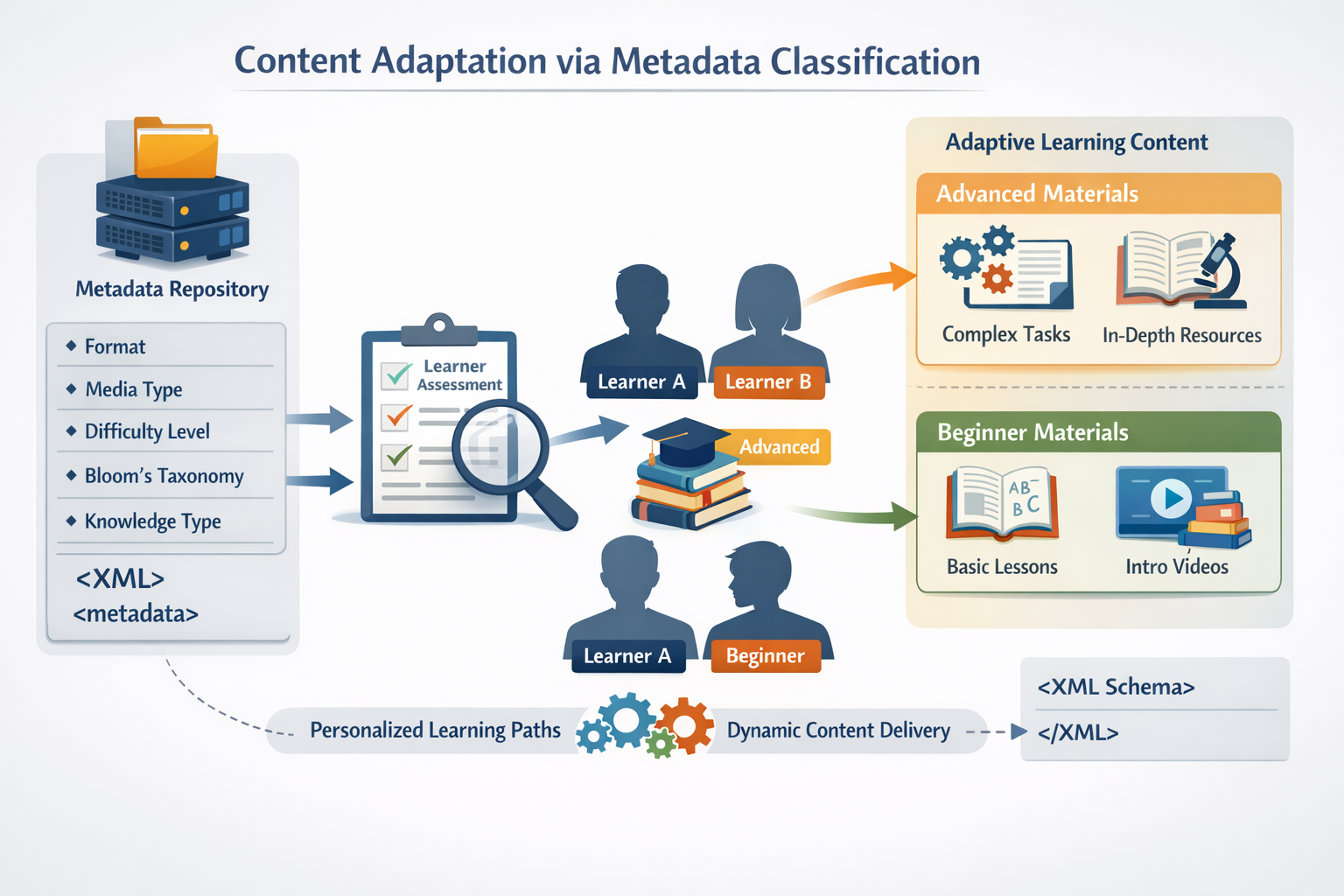
Metadata contains various traits, including physical characteristics (media type, format, location, etc.), knowledge characteristics (knowledge type, difficulty level, etc.) instructional role (such as defined in Bloom’s taxonomy), and relationship specifications (hierarchical, peer, etc.). A strong repository is comprised of a rich collection of materials that represent variety in type, format and instructional method.
Thus, the assessment of learners' charactertistics can be matched with the set of metadata that reflects the nature or the type of adaptation. Example metadata of material could represent different difficulty levels, with learners matched based of either their performance or knowledge level of understanding of the given content.
Therefore, this process supports content adaptation through the use of metadata. Metadata provides structured information that classifies learning objects (LOs), allowing them to be selected and combined to support the dynamic and automatic construction of personalised learning programmes. Metadata can be created using XML technologies and defined through XML schemas. By organising learning resources in this way, metadata facilitates efficient searching and personalisation of adapted learning materials.
Resources
References
- Adorni, G., Battigelli, S., Brondo, D., Capuano, N., Coccoli, M., Miranda, S., Orciuoli, F., Stanganelli, L., Sugliano, A. M., & Vivanet, G. (2010). CADDIE and IWT: Two different ontology-based approaches to anytime, anywhere and anybody learning. Journal of E-Learning and Knowledge Society, 6(2), 53–66. Scopus.
- Béres, I., Magyar, T., & Turcsányi-Szabó, M. (2012). Towards a personalised, learning style based collaborative blended learning model with individual assessment. Informatics in Education, 11(1), 1–28. Scopus. https://doi.org/10.15388/infedu.2012.01
- De Meo, P., Garro, A., Terracina, G., & Ursino, D. (2007). Personalizing learning programs with X-Learn, an XML-based, “user-device” adaptive multi-agent system. Information Sciences, 177(8), 1729–1770. Scopus. https://doi.org/10.1016/j.ins.2006.10.005
- Wanapu, S., Fung, C. C., Kerdprasop, N., Chamnongsri, N., & Niwattanakul, S. (2016). An investigation on the correlation of learner styles and learning objects characteristics in a proposed Learning Objects Management Model (LOMM). Education and Information Technologies, 21(5), 1113–1134. Scopus. https://doi.org/10.1007/s10639-014-9371-3